AI in legal research – can you trust it?

Australian courts have been dealing with the consequences of lawyers turning to AI to draft legal submissions, only to find out the AI had entirely made up case citations. One widely reported case involved an immigration lawyer who filed court documents containing 17 non-existent authorities, all generated by ChatGPT. The Federal Circuit and Family Court referred the matter to the NSW Office of the Legal Services Commissioner, with the judge warning about the risks of relying on “unverified” AI-generated content without proper checks or independent verification (The Guardian). This case and others like it have sparked broader discussion within the legal profession about the role of generative AI in legal practice, and the importance of lawyers upholding their professional obligations, particularly the duty of competence and the duty to the court.

An AI-generated image of a robot writing
How useful are AI tools for legal work? (An AI-generated image …)

A simple test

To test these issues, we asked ChatGPT to generate a short 150-word summary explaining the Australian copyright law principle of “substantial part” in copyright infringement cases, including case references. Here’s what it produced:

“In Australian copyright law, infringement can occur even where only a portion of the work has been reproduced, provided that the portion amounts to a “substantial part.” The test focuses on quality over quantity—even a small excerpt may infringe if it captures essential elements of the original work. The question is whether the part taken embodies the author’s skill, labour, or originality.

This principle was applied in Autodesk Inc v Dyason (No 2) (1993) 176 CLR 300, where the High Court held that copying even a small section of computer code constituted infringement because it replicated a critical component of the program. Similarly, in EMI Songs Australia Pty Ltd v Larrikin Music Publishing Pty Ltd (2011) 191 FCR 444, the court held that a short musical phrase from Kookaburra reproduced in Men at Work’s Down Under was a substantial part, despite its brevity.”

In this instance, the AI performed relatively well. Both cases are real and correctly cited:

  • Autodesk Inc v Dyason (No 2) is a complex High Court decision involving copyright in computer software where the High Court ultimately reaffirmed their ruling in Autodesk Inc v Dyason (No 1) and determined that copying a functional but original look-up table amounted to reproducing a substantial part of the computer program.
  • The key issue in EMI Songs v Larrikin Music was whether Down Under, the iconic Australian anthem by Men at Work, infringed the copyright in the song Kookaburra. The court determined that the Down Under recordings reproduced a substantial part of the song, which constituted copyright infringement.

The summary itself was fairly accurate. It explained the core principle clearly (within the limits of 150 words): that Australian courts focus more on the quality than the quantity of what has been copied when assessing whether a “substantial part” has been taken. This was at the heart of the controversy in Autodesk, where the High Court wrestled with the tension between originality and whether something’s functional importance could also make it substantial, albeit minimal. ChatGPT correctly pointed to two of the most well-known cases in this area.

However, this was a relatively safe topic, relying on well-known cases. AI tools tend to produce far more errors and even fabricate cases when asked about more obscure areas of law or lesser-known precedents.

A more complex test

We decided to try ChatGPT on another question: “Write 100 words with case citations on the recoverability of pure economic loss in NSW law”. The response was:

“Under New South Wales (NSW) law, the recoverability of pure economic loss is generally limited. Pure economic loss refers to financial loss not resulting from physical damage to a person or property. In Demerara Distillers Ltd v. Fair Trading [2018] NSWCA 266, the Court held that pure economic loss is typically not recoverable in negligence unless there is a special relationship between the parties, as seen in Sullivan v. Moody [2001] HCA 59. Courts apply a restrictive approach to prevent indeterminate liability, adhering to the principle that recovery for economic loss should be confined to situations with proximity or reliance.”

Looks plausible? As far as we can tell, the first cited case doesn’t exist, and the case citation belongs to an unrelated case – though there is an interesting-looking Jamaica Fair Trading complaint involving Demerara Distillers and the geographical indication for “Jamaican Rum”.

The second case does exist at its citation, but the run-on sentence suggests that it includes a determination on pure economic loss, which is not the case – it’s about the existence of a duty of care. In the relevant recent High Court decision Mallonland Pty Ltd v Advanta Seeds Pty Ltd [2024] HCA 25, the first case is not mentioned, and Sullivan is mentioned in the context of evaluating the existence and scope of the duty, rather than in the context of pure economic loss.

What does ChatGPT itself say about its legal knowledge?

When asking ChatGPT what its general legal knowledge was on Australian case law, this is what came up:

“My legal knowledge is current up to mid 2024, including Australian law. However, it can access the most recent legal cases, news, or legislative updates through web search in real time.”

That is one of the risks that courts and regulators have been warning about. Anything newer would still need to be researched on legal databases to ensure accuracy.

What about client confidentiality?

AI tools are certainly useful for summarising documents and even creating plain-language versions of advices. But the warning is on the label: “Don’t share sensitive info. Chats may be reviewed and used to train our models.” So, lawyers and consultants must take care not to upload material without first redacting anything that is confidential to the client.

AI can be useful as a starting point for legal research, or early drafting, but human review remains non-negotiable. While these tools can offer a starting point, they should not replace thorough legal analysis or proper source-checking, no matter how convenient the technology might seem.

Author: Ashna Govil, graduate lawyer.

Copyright byline: NY Times sues OpenAI & Microsoft

The New York Times made progress last month in its legal action against Open AI and Microsoft, with a New York federal judge issuing an opinion stating that the newspaper has made a case that the defendants are responsible for inducing users to infringe its copyright through ChatGPT’s use of NY Times articles to produce its output.

Background

The NY Times was among the first major media organisations to challenge generative A.I. models, taking action against OpenAI and Microsoft in 2023.

Newspaper and laptop
Photo by Anna Keibalo on Unsplash

The NY Times argues that language models used in training ChatGPT and Microsoft’s Copilot engage in plagiarism by reproducing published articles in their output. The media organisation describe ChatGPT output as reciting Times content verbatim and mimicking expressive style. The NY Times has also put forward that generative AI models threaten the economic integrity of journalism by providing substitute outlets for information without permission or payment.

The NY Times has sought orders that OpenAI and Microsoft should compensate them for copyright infringement and destroy any training data extracted from its website or printed publications.

OpenAI’s response

OpenAI has maintained the position that the claim against it is without merit. It states that ChatGPT is trained on publicly available material in a way that is grounded in fair use, also accusing the NY Times of creating prompts that push ChatGPT to mimic published articles. While OpenAI has agreed that its language models are trained using material from across the web, the company’s position is that reciting content verbatim is a rare failure of the tool, and that intentionally manipulating ChatGPT to regurgitate third party content is contrary to its terms of use.

Current status

This order allows the NY Times to continue pursuing its claims against OpenAI and Microsoft, in contrast to last year’s judgement in California which rejected claims by authors, whose works were allegedly used to train ChatGPT, that the output of generative AI systems violates the rights of copyright owners.

Author: Zaki Zeini, paralegal.

Hobbit havoc: fan-fiction faces the copyright Eye of Sauron

Background

In 2022, Demetrious Polychron, a US author, created and released his own continuation of the beloved ‘The Lord of the Rings’ series by J.R.R. Tolkien. Following the debut of Amazon’s prequel series ‘The Rings of Power’, Polychron took legal action in April 2023 against both Tolkien’s estate and Amazon. Polychron alleged that their series had used elements from his work, constituting copyright infringement. However, the case brought by Polychron was dismissed after a Californian judge concluded that the author himself had infringed copyright by profiting from a work that directly utilised characters and storylines owned by the Tolkien estate and Amazon.

Book
Originality is the threshold for copyright protection.

In a subsequent turn of events in June 2023, Tolkien’s estate initiated a separate lawsuit against Polychron. Their claim centred on the fact that the author had published a derivative work without the necessary authorisation from the owners of ‘The Lord of the Rings’ intellectual property. The lawsuit against Polychron proved successful, resulting in the presiding judge issuing a permanent injunction against the author.

The presiding judge remarked that Polychron’s request for copyright protection was “unreasonable” and “frivolous” because his work was completely based on characters from The Lord of the Rings.

This injunction prohibits Polychron from publishing or selling his derivative work and mandates the destruction of all existing copies of the author’s work.

Authorship protection in Australia

In Australia, the Copyright Act 1968 (Cth) safeguards published and unpublished books as ‘literary works’. When someone creates a literary work, like a book, they become the owner for a duration of time. This ownership grants them the sole right to copy, publish, modify, or share their work with the public. There is no need for authors to officially register their work to secure copyright protection for it.

For a literary work to gain copyright protection in Australia, a few criteria must be met:

  • the author should be an Australian citizen,
  • the work must have been initially published in Australia, and
  • it needs to be an original creation.

If someone carries out actions that fall within the exclusive rights granted to the copyright owner without their permission, they could be infringing upon the copyright of the original creator. This means reproducing, publishing, adapting, or sharing it with the public can lead to a copyright infringement claim.

If you would like guidance regarding potential copyright infringement or the scope of your copyright protection, please contact us.

Author: Zaki Zeini, paralegal.

Remember to express your IP licences clearly!

The recent decision in Realestate.com.au Pty Ltd v Hardingham [2022] HCA 39 overturned a significant copyright ruling and has potential for significant flow-on effects for photographers and other content creators.

Background

House for sale
Real estate photographers will need to adjust how they do business after this decision.

Hardingham, an independent real estate photographer, took photos of properties for real estate agents under oral contracts. The agents uploaded the photos to realestate.com.au (REA). REA then provided the photos to RP Data, a service that allows real estate agencies to use photos for property marketing campaigns.

When agents uploaded the photos to REA, they accepted clickwrap terms which gave REA “an irrevocble and perpetual licence to use the content … for any purpose related to our business”. RP Data argued that this licence meant it was able to use the photos once permitted to do so by REA. Hardingham contended that the licence had to be subject to a limitation so that it ended once the property was sold or leased.

At first instance Thawley J found that the sub-licence from REA to RP Data should be permitted because it was inferred from the parties’ conduct and should be implied to give business efficacy to the arrangements. It was not subject to any time limit.

On appeal to the Federal Court, the Full Court found that they were not satisfied that the terms should be implied or inferred, and that any implied licence did not extend beyond the property marketing campaign.

High Court

In December, the High Court overturned the Federal Court’s decision. The question, in this case, was what a reasonable person would consider, based on the parties’ words and conduct.

The Court found that there was nothing in the oral contracts, between Hardingham and the original real estate agencies, to suggest that the photos could not be used after the campaign. They all knew that the photos uploaded to REA and RP Data remained there after the completion of the campaign and on a history tab for the property. That had been the case for a number of years.

So, the real estate agencies were capable of licensing the photos to REA on its standard terms, and REA was capable of licensing them to RP Data. Accordingly, RP Data did not infringe Hardingham’s copyright.

Action

This case has important implications for photographers and other content creators, and is an important reminder to put clear, written agreements in place when licensing copyright and other IP. You can exclude implied terms and make sure that the parties’ expectations match. If you would like assistance with documenting your copyright agreements, contact us.

Author: Ashna Govil, paralegal.

NAIDOC Week and the recognition of Indigenous Cultural & Intellectual Property (ICIP)

This year we are celebrating NAIDOC Week from 8 – 15 November 2020. NAIDOC Week was once a day celebrated by Aboriginal and Torres Strait Islander peoples but has now become an important week for all Australians to celebrate and appreciate Aboriginal and Torres Strait Islander people, history and culture.

2020 National NAIDOC logo

The NAIDOC Week theme for this year is ‘Always Was, Always Will Be’ which focuses on Aboriginal and Torres Strait Islander peoples’ continuous connection to country and culture. The richness and survival of Aboriginal and Torres Strait Islander culture is essential. However, Australian law fails to recognise properly the importance of Aboriginal and Torres Strait Islander culture and Aboriginal and Torres Strait Islander peoples’ rights to protect their intellectual property, which is also known as Indigenous Cultural and Intellectual Property (ICIP).

ICIP encompasses different aspects of Indigenous culture, including, stories, symbols, sacred sites, dances, ceremonies etc. While you could write a story and it would fall under copyright, if it meets the specific requirements under the Copyright Act 1968 (Cth), there are roadblocks which prohibit ICIP from being protected by copyright. In particular, the requirements of ‘material form’ (e.g. written down or recorded) and there being an ‘author’ poses problems as Aboriginal and Torres Strait Islander stories are told orally, and a community may be the owner of a story rather than a person. The duration of copyright which can last for 25, 50 or 70 years after the creator’s death, the first year of publication/broadcast, since being made or made public, depending on the work is also problematic for ICIP. We know that Aboriginal and Torres Strait Islander people and culture have been around for more than 65,000 years, which means that particular ICIP may be older than the current duration period of copyright.

Aboriginal and Torres Strait Islander people and various organisations have advocated for the recognition of ICIP in Australia. Dr Terri Janke and Company have done great work to educate people about the importance of recognising and respecting ICIP as well as protocols to follow regarding the use of ICIP. Also, in 2016, the Arts Law Centre of Australia, Indigenous Art Code and Copyright Agency started the ‘Fake Arts Harms Culture campaign’, which highlighted issues with fake Aboriginal and Torres Strait Islander art and the lack of protection of ICIP. In September 2020, the ‘Australian Government response to the House of Representatives Standing Committee on Indigenous Affairs—Report on the impact of inauthentic art and craft in the style of First Nations peoples’ recognised the problems with current intellectual property laws and the need start looking into the development of ICIP legislation. While the Government has said this will be a long process, hopefully, we will see the introduction of ICIP laws sooner rather than later.

Author: Sharna White, Graduate Lawyer

influence legal acknowledges the Traditional Custodians of Country across Australia. We recognise the strength, resilience and capacity of Aboriginal and Torres Strait Islander Peoples and pay respect to Elders past and present.

When the copyright owner can’t be found

Whether it is a photograph you would like to use on your website, or an artwork you wish to print onto merchandise, it’s always best practice to seek permission from the copyright owner to use their work. What happens when you want to use a work protected by copyright and cannot find the copyright owner, even after making every effort to find them? These are known as orphan works.

Orphan works and how the Copyright Act deals with them

influence legal book search
What happens when you can’t find the copyright owner?

Currently, the Copyright Act does not provide any specific protection for those using orphan works. If a copyright owner turns up even after the user has made reasonable efforts to find them, then the user is at risk of an infringement claim.

This issue has been reviewed in several enquiries, including the Australian Law Reform Commission Inquiry into Copyright and the Digital Economy and Productivity Commission Inquiry into Intellectual Property Arrangements.

The Federal Government’s Copyright Access Reforms – what does this mean?

On 13 August 2020, the Federal Government announced that one of their five reforms to the Copyright Act is the establishment of “a limited liability scheme for use of orphan works”.

The Government indicated that the scheme will benefit the copyright owner and the person using an orphan work. The proposed amendment will allow orphan works to be used without the risk of copyright infringement provided that the person intending to use the work conducts “a reasonably diligent search” and attributes the creator “as far as reasonably possible”.

If the copyright owner does appear then the person using the orphan work will be entitled to use the work, if both parties can agree on “reasonable terms”. If this cannot be achieved, the copyright owner can apply for an injunction to prevent future use of the work.

These reforms will be an area to watch this year, as the Government anticipates the release of an exposure draft bill later this year. It will be interesting to see if and how “a reasonably diligent search” is defined, as they have suggested that specific sectors and industries develop policies about a “diligent search”.

Author: Sharna White, Graduate Lawyer

Update – control of online content

Our last article looked at the issue of control of copyright on social media platforms following the recent case, Sinclair v Mashable.

Only 2 months after the Sinclair decision, the U.S. District Court for the Southern District of New York has revised its position in a new case, McGucken v Newsweek.

A tale of two cases

In very similar conditions to Sinclair, Newsweek had published an article featuring an embedded Instagram post of photographer, Elliot McGucken, without his permission.

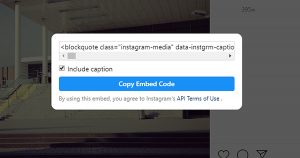
Instagram embed
Instagram has released a statement on its embeds API

Relying on the ruling in Sinclair, Newsweek argued that because the image was posted to McGucken’s ‘public’ profile, it could rely upon Instagram’s terms of service.

However, despite the Sinclair decision, the court refused to dismiss McGucken’s case. While the court did accept that Instagram has the right to sublicense publicly posted photographs to other users, it concluded that there was insufficient evidence to prove that Instagram had sub-licensed the photo to Newsweek.

Instagram weighs in

Instagram has released a statement clarifying its position on the issue, stating:

“While our terms allow us to grant a sub-license, we do not grant one for our embeds API… Our platform policies require third parties to have the necessary rights from applicable rights holders. This includes ensuring they have a license to share this content, if a license is required by law.”

So, the court’s decision combined with Instagram’s statement on the issue has now emphatically altered the legal position set out in Sinclair.

What does this mean for you?

Photographers and other creators wishing to have stronger control over their copyright when sharing their photographs online will welcome this development.

However, this decision also serves as a strong warning to businesses (especially digital media outlets) to ensure they obtain the correct permissions before using or embedding a photographer’s work onto their website.

Who controls the copyright in your online posts, really?

In a recent article we looked at how important it is for artists and content creators to ensure they have a written, signed contract for any licence agreement. A recent New York case highlights the strict licensing terms on social media platforms and the trade-off between exposure for your content, against control of your works.

Sinclair v Mashable – what happened?

Stephanie Sinclair is a renowned photographer whose portfolio includes works featured in The New York Times, Time Magazine and National Geographic. Like many creators, Sinclair uses Instagram as a platform to share her works.

influence legal apps
Do you understand what you’re agreeing to when you upload content?

Sinclair uploaded one of her photographs (an image of a mother and child in Guatemala) to her Instagram account. She was then contacted by digital media and news website, Mashable, offering $50 in exchange for a licence to use the photograph for a story on female photographers. Sinclair declined the offer.

Undeterred by the refusal, Mashable went ahead and used it anyway, taking advantage of Instagram’s API to embed her post of the photo in their website. Mashable didn’t make a copy of the photo – just linked back to the photo on Instagram – but the overall effect was the same. When Mashable refused to remove the embedded post, Sinclair commenced proceedings for copyright infringement.

A not-so picture perfect judgment

On face value, it might seem fairly straightforward that by using Sinclair’s copyright work without her permission, Mashable had infringed her copyright.

However, in this case, the devil was in the details – specifically, in Instagram’s Terms of Service (TOS).

Judge Kimba Woods found that by creating an Instagram account, Sinclair had agreed to Instagram’s TOS. These TOS included a term granting Instagram a “non-exclusive, fully paid and royalty-free, transferable, sub-licensable, worldwide licence to the Content.”

The judge determined that when Sinclair posted the photo to her public Instagram profile, she had “granted Instagram the right to sublicence the photograph, and Instagram validly exercised that right by granting Mashable a sublicense to embed and display the Photograph on their website.”

Even though Sinclair had refused to license the photo directly, Mashable could still validly obtain a sub-license from Instagram to embed the photo.

Private v public

Sinclair argued that Instagram’s TOS were unfair. Users must decide between either:

  • choosing to have a private profile and losing out on the advantages of sharing their works on the biggest photo sharing platform in the world, or
  • choosing to have a public profile in exchange for surrendering rights in their uploaded content to Instagram.

In her judgment, Judge Woods acknowledged the difficulty of this position, but determined that Instagram’s TOS were binding:

“Instagram’s dominance of photograph- and video-sharing social media, coupled with the expansive transfer of rights that Instagram demands from its users, means that [Sinclair]’s dilemma is a real one… But by posting the photograph to her public Instagram account, Plaintiff made her choice. This court cannot release her from the agreement she made.”

What does this mean for you?

As an artist or content creator, it is likely that you will rely on social media as a major platform for sharing your work. And while it is incredibly important to share your work with the public, there is another very important thing to consider; and it’s also one of the most ignored – the fine print.

The terms and conditions for online platforms, including Instagram, often contain broad terms applying to any content you upload – including the right to sub-license to third-party websites.

Sinclair’s case serves as a great reminder that when signing up to any online sharing platform, it is always worth taking the time to understand the terms you are agreeing to. You may not be able to negotiate the terms, but you can choose which works you share and make sure you retain practical control over valuable content.

Author: Blake Motbey, Associate

Licensing your copyright? Get it in writing!

As an artist or content creator, licensing your artworks and content can be one of your most important and rewarding streams of income. As well as getting your work out there, ensuring that you are paid appropriately and your works are protected arejust as important.

Make sure your licence contracts are in writing.

Unfortunately, many artists and creators often make unwritten or informal arrangements when licensing their copyrighted works to others.  Whether this is based on the assumption that it’s unnecessary to enter into a contract, that it’s safer to work under an informal agreement, or simply trusting that the licensee will do the right thing, operating without expressly written terms can pose significant risks for artists and creators .

The recent case of Hardingham v RP Data Pty Ltd demonstrates just how easily issues can arise from informal or unwritten copyright licencing arrangements – especially if your works are being uploaded to third party websites.

Hardingham v RP Data – what was the issue?

Mr Hardingham is a professional photographer who provided photographs and floorplans to real estate agencies to be used in marketing campaigns for the agencies’ listed properties, including for listings on realestate.com.au, which had standard terms for agents. These terms include a broad licence of uploaded content.

However, these photographs and floorplans were then reproduced and uploaded by a third-party company, RP Data, under a separate sub-licensing agreement with realestate.com.au.

Mr Hardingham commenced court proceedings claiming that RP Data had infringed his copyright in his images and floorplans.

Well if Hardingham didn’t license the works to RP Data, they shouldn’t be able to use his works, right?

Unfortunately for Mr Hardingham, this was not the case.

While it may have been his initial intentions that the licence granted to the agencies was for house marketing purposes only, and that no sub-licence could be granted, the court took a different view.

As there was no formal written contract between Hardingham or his company and the agencies, the court relied on evidence surrounding the context and the commercial arrangements between each of the parties. The court said that these factors meant that realestate.com.au had a licence, and was able to grant a sub-licence to RP Data. This right was either:

  • inferred from the conduct of the parties’, or
  • implied into the agreements in order to give business efficacy to the agreements.

The lack of any formal or written licensing agreement between Mr Hardingham and the agencies was a crucial factor that allowed for the legal sub-licence of the works.

Get on the same page – literally!

Without a formal licensing agreement, you are putting yourself at the risk of your works or content being used or reproduced without your permission. As a result, you can incur significant financial loss by missing out on important licensing fees you would otherwise have negotiated for.

So, if you are an artist, creative or content creator and are planning to license your copyright works to others, you should always make sure you have the crucial terms of your licence arrangement set out in a written, signed contract.

If you’d like to put together a standard licence for your works, contact us.

Author: Blake Motbey, Associate

Time to review your IP arrangements

In February this year, the Federal Parliament passed the Treasury Laws Amendment (2018 Measures No. 5) Bill 2018 (Act), repealing the intellectual property exemptions under section 51(3) of the Competition & Consumer Act 2010 (Cth) (CCA).

The repeal is set to come into effect on 13 September 2019.

What’s section 51(3)?

Section 51(3) covered contractual terms in licences and assignments of patents, designs, copyright and EL rights, and specified agreements in relation to trade marks.

Do your IP contracts need review?

The section provided a limited exemption for IP rightsholders, to allow them to make arrangements that would otherwise be prohibited under the CCA. So, for example, a generally anti-competitive term, or a cartel provision, which met the requirements of section 51(3), would be permitted.

The background of the section was the perceived conflict between the monopoly rights of IP rightsholders, and the competition provisions under the CCA, meaning that IP rights needed this exemption.

What’s the background to the changes?

Section 51(3) has had a life under the microscope, with consistent review and advocation for its repeal for quite some time. It was reviewed in the Hilmer Report, as well as in a number of subsequent competition reviews.

More recently, the Productivity Commission’s Inquiry into Intellectual Property Arrangements, released in late 2016, considered the balance between access to ideas and products, and the encouragement of innovation and investment.

The report recommended the repeal of section 51(3) on the basis that IP rights did not have significant competition implications, and issues only arose where there were few substitutes or where IP rights aggregation could create market power.

The Commission considered that there would be increasing benefits to repeal, especially in the pharmaceutical and communications markets, as the level of licensing and cross-licensing rises in the future.

 Where does this issue arise?

There have been very few cases where section 51(3) has been considered – in fact the ACCC stated in its 2016 submission to the Productivity Commission that it was not aware of any cases where section 51(3) had been used successfully as a defence.

That said, it’s anecdotally clear that IP rightsholders have relied on knowing that section 51(3) was there, in structuring agreements, and there are several situations where regulators and courts have considered a tension between IP rights and competition regulation. These include:

  • Exclusive dealing – such as where rightsholders impose restrictions on distributors about their permitted suppliers or customers. For example, in Transfield v Arlo [(1979) 144 CLR 83 at 108, the Court considered whether Transfield was obliged to sell exclusively promote and sell Arlo’s steel pole. Wilson J was of the view that if a contract clause requiring a licensee to use its ‘best endeavours’ to sell a patented product meant that the licensee could not sell competing products, it would have been protected by section 51(3).
  • Geo-blocking – where rightsholders impose geographical restrictions on the basis of consumer nationality or location. The EU recently regulated geo-blocking with Regulation 2018/302. The European Commission subsequently found that clothing company, Guess, violated the regulation by restricting authorised retailers from selling cross-border to consumers within the EU single Market, allowing them to maintain artificially high retail prices.
  • Assignments-back – In the US, Pilkington Glass was found to have built up a dominant position in the glass manufacturing market by requiring licensees to assign back improvements to Pilkington’s processes. Consequently, the court prohibited Pilkington from imposing territorial and use limitations on their US licensees, allowing them instead to manufacture and sublicence anywhere in the world, free of charge, using the technology in the licences.

What will happen when the repeal comes into effect?

When the repeal takes effect this September it will operate retrospectively, meaning p

We can anticipate that with this change, the ACCC will have an increased focus on IP-heavy arrangements and compliance activities to ensure businesses understand their new obligations under the CCA.

The ACCC has stated that they are in the process of writing guidelines to assist businesses in complying with the repeal, but while we wait for these, we can expect that agreements including the following aspects will be of interest:

  • Exclusive arrangements, territory restrictions, geo-blocking and assignments-back, as mentioned above;
  • Licences that impose quantity restrictions on the licensees, split licensees’ rights by reference to customers, or involve bid-rigging;
  • Bundling and third-line forcing, where the licensee has to accept other products from the licensor or a third party;
  • Patent pooling arrangements – these are agreements where companies with related patents cross-license them to each other and agree on the terms of licence agreements to parties outside the pool; and
  • Clauses that provide for a first mover advantage or “pay for delay”, where one party pays the other to agree not to commercialise a product or move into a market.

Now is the time to review

With the commencement date fast approaching there is still a window of time to ensure that your existing IP arrangements will comply with the repeal.

If you have any concerns or questions about the potential impact of the repeal on your IP licensing, assignment or distribution arrangements, please contact us.

Author: Blake Motbey, Paralegal.